Addressing the Perceptual Blind Spot in Automotive Certification
Whole Vehicle System Integrity Testing (WVSIT); Driver Visibility; Dashboard Reflection; Optical Glare; Ocular Fatigue; Human Factors
Current automotive safety standards focus on individual components, but modern designs create dangerous optical reflections that impair driver visibility. This article introduces Whole Vehicle System Integrity Testing (WVSIT) as a necessary evolution to ensure real-world perceptual safety.
The Limitation of Component-Centric Certification
Automotive safety certification frameworks worldwide remain predominantly component-centric, focusing on the validation of individual subsystems such as glazing
(UNECE R43), dashboard materials, and interior trims. This historical approach assumes that if each individual component meets its prescribed requirements, the assembled vehicle will be safe. However, this assumption has become increasingly tenuous as design complexity has increased.
While current standards are effective in preventing
structural failures and ensuring material durability, they
do not sufficiently address perceptual safety risks that
emerge from the interaction of compliant components
under real-world operating conditions. In high-irradiance environments, particularly in tropical and subtropical regions, the combined effects of windshield geometry, dashboard surface reflectance, and solar incidence can generate optical artifacts that impair driver visibility and reaction time—all without violating any existing regulatory requirement.
The Optical Geometry of Hazard
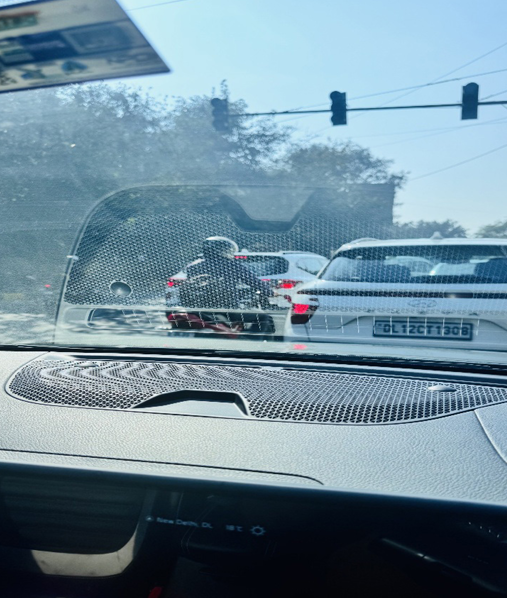
Reflection-induced perceptual hazards arise from predictable and well-understood principles of optical geometry. When sunlight enters the vehicle cabin, it interacts with interior surfaces; even those classified as “matte” exhibit both diffuse and specular reflectance. During morning and afternoon hours, solar rays often strike the dashboard at shallow angles, projecting reflected light upward onto the inner surface of the windshield and then redirecting it into the driver’s forward field of view.
The resulting virtual image frequently appears super
imposed on the external scene, occupying the same perceived depth plane as the road ahead. This superposition reduces contrast and introduces visual noise,

Ocular Fatigue and Interior Design Trends
Ocular fatigue arises from sustained visual effort under suboptimal conditions, contrib uting to eye strain, dryness, and discomfort. These symptoms have cumulative effects on alertness and concentration. Drivers expe riencing persistent visual strain may exhibit slower information processing, reduced situational awareness, and increased reliance on habitual responses rather than deliberate judgment.
making it more difficult for the driver to distinguish critical features such as pedestrians, cyclists, lane markings, and traffic signals. Windshield rake angle plays a decisive role: as angles become shallower for aerodynamics or styling, the probability of these reflections intersecting the driver’s line of sight increases significantly.
Human Factors and Glare Sensitivity
Driving is fundamentally a perceptual task requiring a driver to continuously interpret a complex visual scene. The human visual system is highly adaptable but operates within finite physiological limits. Glare reduces contrast sensitivity, compresses dynamic range, and increases the time required for the eyes and brain to adapt to changing
luminance conditions.
From a cognitive perspective, glare functions as “visual noise.” 18The brain must allocate additional processing
resources to suppress irrelevant stimuli before extracting meaningful information from the scene. This reallocation of cognitive capacity increases reaction time; while these delays may be measured in milliseconds, they can trans late into several meters of additional stopping distance at highway speeds.
Furthermore, age is a critical factor. As drivers age, intraocular scatter increases and the speed of glare recovery decreases. Design-induced reflections that may be tolerable for younger drivers can become safety-critical for older populations, a concern that grows in relevance as global demographics shift toward an older driving population.
Modern vehicle interior trends emphasize expansive surfaces and premium textures. 27 While large, uninterrupted dashboards and high-contrast color schemes enhance perceived quality, they also increase the potential for unwanted optical interactions. 28For example, dark, smooth surfaces may produce high-contrast reflections, while lighter surfaces (such as beige or light grey) can generate diffuse veiling glare. These design decisions, made in isolation, may appear benign yet produce dangerous perceptual effects when integrated.
The WVSIT Framework: A Proposed Protocol
To move from “Safe on Paper” to “Safe on the Road,” the paper introduces Whole Vehicle System Integrity
Testing (WVSIT). This framework evaluates vehicles as integrated perceptual systems where safety-critical properties emerge from subsystem interactions.
Key elements of the proposed WVSIT protocol include:
- Static High-Irradiance Test: Placing the vehicle
in a light-controlled chamber with a “Solar Simulator” producing $1,000 W/m^2$ to mimic an Indian summer day. - Luminance Contrast Measurement: Positioning a calibrated photometer at the “Eye-Ellipsoid” (standard driver’s eye position) to measure the brightness of a “Hazard Target” placed 50 meters ahead.
- Reflection Interference Threshold: A vehicle fails if the dashboard’s reflection reduces the target’s visible contrast by more than 15%.
- Manual Contradiction Audit: Any vehicle that includes an owner’s manual warning regarding dashboard reflections should undergo an automatic audit to determine if the factory material exceeds allowable reflectance limits.
Consumer Empowerment: The Visibility Checklist
Until integrated testing becomes a regulatory requirement, consumers can take practical steps to assess visibility during midday test drives:
- The Shadow Test: Drive toward a shadowed area (like an underpass) to see if dashboard reflections “wash out” the ability to see into the darkness.
- The Texture Check: Look for “Ghost Images” of speaker grilles or defrost vents.
- The Colour Assessment: Note if light-colored dashboards (beige/grey) reflect significantly more than dark, matte surfaces.
- The Hand Test: Place a dark, matte cloth on the dash; if visibility improves instantly, the factory design is optically defective.
- The Rake Angle Observation: Be wary of highly tilted windshields where the dashboard surface appears as large as a dining table.
Conclusion: A Call for Evolution
Safety is not a checklist of parts; it is the integrity of the whole system. As materials, manufacturing, and design philosophies evolve rapidly, safety standards must be treated as “living documents” with periodic reviews to incorporate emerging knowledge from human-factors
research and optical engineering. By shifting focus from component compliance to perception integrity, we can align certification practices with the realities of modern driving.